Off-site Stormwater Quality Improvement Program
In 2012, council introduced a policy in its planning scheme that allowed eligible developers to voluntarily pay fees instead of meeting their statutory responsibilities for reducing stormwater pollution on development sites (i.e., on-site). In this situation, council inherits the developer’s statutory responsibilities and delivers projects off development sites (i.e. off-site) that achieve an equal or greater reduction in stormwater pollution.
In 2014, council started accepting fees from developers. Around the same time, it began a program of works to meet its inherited pollution reduction responsibilities. This program of works has evolved significantly over the years and is now formally known as the Off-site Stormwater Quality Improvement Program (Program).
What does the program deliver?
The projects that council delivers through the Program, which it calls off-site solutions, can involve designing and constructing a range of stormwater treatment devices and other works. To ensure the best outcomes, these projects must also provide multiple economic, environmental and social benefits to the Ipswich community.
Bioretention basins
These are shallow, landscaped depressions that capture and treat stormwater through filtration with an engineered soil and vegetation. They remove sediments, nutrients and other pollutants while allowing water to infiltrate or be slowly released into waterways. These systems also reduce the velocity of stormwater entering waterways and increases urban green space.
Bioretention basin in Ipswich
Constructed wetlands
Constructed or ephemeral wetlands are low-lying areas that temporarily or permanently hold and treat stormwater through a combination of slowing, filtering and biological processing. Ephemeral wetlands dry out between rainfall events, while constructed wetlands often retain water year-round. Both improve water quality, reduce stormwater velocity and improve biodiversity.
Constructed wetland in Eastern Heights
Water smart street trees
Water smart street trees function in a very similar way to bio-retention basins but are much smaller and typically constructed in the road verge. They divert stormwater from the kerb into a small, depressed area, where it is filtered with an engineered soil and vegetation. The stormwater nourishes and helps the tree and other native vegetation to grow.
Water Smart Street Tree installation
Channel naturalisation
Channel naturalisations involve reshaping and revegetating engineered drainage infrastructure to better mimic natural waterways and their processes. This includes adding meanders, riffles, pools and native vegetation to slow stormwater and improve habitat. Naturalised channels enhance ecological function, reduce erosion and improve visual amenity.
Small Creek naturalisation in Raceview
Floodplain re-engagement
Re-engagement involves reconnecting stormwater with floodplains and wetlands by diverting runoff into these areas. This allows stormwater to spread across the land and be treated in the same way as constructed and ephemeral wetlands. Re-engagement improves local flood resilience, ecosystem health and ecological connectivity.
Floodplain re-engagement in Bellbird Park
Waterway stabilisation
Waterway stabilisation involves reducing the erosion of soils into waterways through a combination of structural elements and revegetation. This may include rock armouring, snagging (i.e. adding logs and rootballs of fallen trees to waterways) and installing pile fields. Stabilisation improves waterway resilience, protects infrastructure and supports ecological recovery.
Waterway stabilisation in Woogaroo Creek
New project: Heit Family Park
A section of Heit Family Park in Willowbank is being investigated for revegetation and the construction of a bioretention basin. The project would be designed to improve the quality of stormwater entering Warrill Creek, while enhancing the natural beauty of this location.
Read the Development Information letter and factsheet(PDF, 2MB)
Project update: Bremervale Park
An ephemeral wetland is being constructed in a section of Bremervale Park in Raceview. The project would be designed to improve the quality of stormwater entering Bundamba Creek, while providing habitat and scenic amenity. It is expected construction will commence in August-September 2026 (weather dependent).
Read the Project Update factsheet(PDF, 606KB)
How does the program work?
Participation in the Program is voluntary. A developer can make a request to participate in the Program through the development application process. If approved, the developer pays the required fee to council. Council then uses those funds to plan, design and construct off-site solutions at other locations in Ipswich (not within the development area). Not all development sites are eligible to participate. For example, council does not approve development sites that discharge to sensitive receiving areas. Council also does not approve Material Change of Use (MCU) development or development sites within priority development areas such as the Ripley Valley Priority Development Area. Further information about the eligibility, rules and requirements for participation in the Program can be found in council’s Off-site Stormwater Quality Improvement Guidelines and Policy.
Why have the program?
The Program helps to avoid:
- The technical difficulties and sometimes impossibility of delivering well designed and constructed stormwater treatment devices on constrained development sites (e.g. sites that are too small or steep to fit them).
- The costs and logistic challenges associated with ensuring smaller, privately-owned stormwater treatment devices are being maintained for both council and private property owners.
- The costs and negative outcomes associated with rectifying poorly designed and constructed stormwater treatment devices that are handed over to council ownership.
The Program provides flexibility to the local development industry when it comes to meeting stormwater pollution reduction targets on-site. It also provides council with the ability to plan and deliver off-site solutions in a holistic and integrated way across Ipswich, which may ultimately lead to better economic, environmental and social outcomes for the community.
However, council recognises that off-site solutions are just one tool and in the first instance, seeks to align planning and development in Ipswich with best practice stormwater management. Consistent with the Queensland State Planning Policy and associated best practice guidelines, this involves conditioning that all new developments meet pollution reduction responsibilities on-site to the greatest extent possible using water sensitive urban design principles and practices.
Program achievements
Major off-site solutions delivered include the award-winning Jim Donald Parklands constructed wetlands and Small Creek channel naturalisation. Together, these projects have prevented approximately 960 tonnes of suspended solids entering Ipswich’s waterways each year as well as700 kilograms of phosphorous, 1400 kilograms of nitrogen and 75 tonnes of gross pollutants. While only spending 41 per cent of the fees collected from developers, these projects have substantially reduced and sometimes well exceeded council’s statutory pollution reduction responsibilities. These results demonstrate the overall value of the Program and council’s approach to off-site stormwater quality improvement in Ipswich.
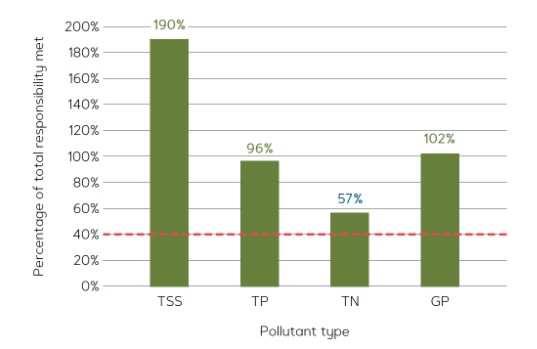
Graph: Progress toward meeting council's water quality offset responsibilities
- TSS: Total Suspended Solids
- TP: Total Phosphorous
- TN: Total Nitrogen
- GP: Gross Pollutants
Council carefully selects the projects it delivers to ensure off-site solutions maximise stormwater pollution reductions while also providing multiple economic, environmental and social benefits to the Ipswich community.
These benefits include:
- Stormwater pollution reductions
- Reduced demands on the stormwater network
- Improved local flood resilience
- Improved local biodiversity
- Increased carbon capture
- Cooling, greening and shading
- Improved active transport and recreation.
Annual reporting
Council is committed to reporting on the Program to ensure it is operated transparently, and to start conversations and share learnings among relevant stakeholders. The report summarises important information about the Program for each of the financial years it operates. This includes the fees council collected from participating developers, how the funds have been spent, the stormwater pollution reductions and other benefits achieved, and the challenges identifiedand overcome. Program reporting also assists with continued improvement, ensuring council operates the Program in a way that meets its statutory responsibilities while maximising benefits for Ipswich.
Changes to the Program
In late 2022, council undertook a review of the Program to ensure it can meet the responsibilities it inherits from developers participating in the Program in the future. The review has driven several changes to the Program which are summarised in the fact sheet below.
Example projects
Franklin Vale Creek Initiative
Council has worked with landholders to restore Franklin Vale Creek, on Ipswich’s western boundary.
The instability and bank erosion of this creek impacts water quality entering the Bremer River, the biodiversity values of this wildlife corridor and the productivity of graziers.
Actions include revegetation, offline watering points and stock exclusion fencing.
Find more information on the Franklin Vale Creek webpage.
Small Creek naturalisation
Council has transformed a straight concrete channel in Raceview to a living, naturalised creek.
As well as stormwater pollutant reduction, improved habitat and visual amenity, Small Creek offers path and bikeway connections for the community.
Three stages of this award-winning project are completed, between Warwick Road and Poplar Street Park.
For more information, see the Small Creek webpage.
Water Smart Street Trees
This is an innovative way of diverting stormwater from the kerb to nourish street trees.
The trees capture nutrients and sediments that would otherwise wash into our rivers and creeks.
These sustainable, self-watering street trees are designed to fit neatly into the streetscape and landscape, adding to neighbourhood appeal.
For more information, see the Water Smart Street Trees webpage.
Jim Donald Wetlands
These constructed wetlands in Eastern Heights are an excellent example of multiple benefits from one project.
Stormwater flows into a pond which captures most of the dirt and particles.
The filtered water is harvested for use on the sport fields.
The lush native vegetation provides habitat for species such as frogs and birds, as well as visual amenity.
Ironpot Creek stabilisation
It has a history of being one of Ipswich’s most damaged creeks, with dispersive soils causing severe bank erosion, scouring and sediment.
Since 2019 Council has undertaken works to stabilise sections of Ironpot Creek.
Thousands of native plants and tonnes of rock have been installed.
Early stages have already proved successful at protecting the creek during flood events.